

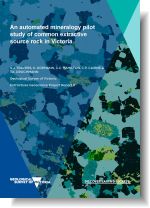
EGPR 9 - An automated mineralogy pilot study of common extractive source rock in Victoria.
 |
| |||||||||||||||||||||||||||||||||||||||||||||||||||||||||
Product description:Executive Summary:As part of the Extractives Geoscience Project, a trial of Advanced Mineral Identification and Characterisation System (AMICS) was completed on 51 drill core samples representing basalt, hornfels and granite that are common source rocks for hard rock construction material production in Victoria. Most samples analysed were sourced from the Newer Volcanic Group on the northern outskirts of greater Melbourne. The purpose was to determine and quantify the mineralogy for each type of source rock and determine whether deleterious mineralogy could be detected. AMICS successfully identified the presence of clay minerals smectite and montmorillonite from the alteration of olivine and glass, in samples of Newer Volcanic Group basalt. The application of X-Ray Diffraction (XRD) is recommended to determine to the clay species with confidence. Only one of the 45 Newer Volcanic Group basalt samples was assessed as unsound for durability according to the Victorian standard for crushed rock and aggregate products used in road construction. The unknown minerals identified in the small number of granite and hornfels samples are likely due to mixed spectra, resulting from fine-grained weathering products (close to the analytical resolution) and fluorescence of adjacent minerals at grain boundaries. In the case of one hornfels sample, the high unknown mineral percentage correlates with high chlorite, biotite and muscovite/illite and is likely to represent alteration and/or intergrowths. Having acquired the AMICS data there is opportunity to integrate with engineering geoscience test work and corresponding geochemistry to evaluate the quality of some of Victoria’s most important source rock. The next step will be to collect and analyse samples of source rock from active quarries and compare these with the results of potential source rock sampled from the drill holes. Bibliographic Reference: Travers, S.J., Goemann, K., Hamilton, C.C., Cairns, C.P. & Drochmann, T.K., 2026. An automated mineralogy pilot study of common extractive source rock in Victoria. Extractives Geoscience Project Report 9. Geological Survey of Victoria, Department of Energy, Environment and Climate Action, Melbourne, 33 pp. Download: The downloadable version of this report is supplied in PDF format (33 MB), Attachment A1 (ZIP 43MB) & Attachment A2 (ZIP 500 kb). Related products:
| ||||||||||||||||||||||||||||||||||||||||||||||||||||||||||