

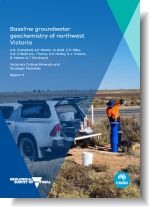
VCMSM Report 11 - Baseline groundwater geochemistry of northwest Victoria.
 |
| |||||||||||||||||||||||||||||
Product description:Executive Summary:New geochemistry data to assess the occurrence of natural elements in groundwater has been collected in northwest Victoria as part of an initial reconnaissance baseline geochemistry study to support delivery of the Victorian Critical Minerals Roadmap. Groundwater samples were collected between May and October 2025 from 161 State observation bores, mainly within the Shepparton Formation, Parilla Sand, Duddo Limestone and Renmark Group aquifers. Most samples were collected using a Perspex flow-through bailer to enable rapid baseline data collection across a study area equivalent to one fifth of Victoria. Groundwater was analysed for element concentrations and stable and radiogenic isotope compositions by several methods. The study included sample locations around demonstrated mineral sand occurrences that are known to include the following elements that are considered critical minerals: titanium, zirconium and rare earth elements + yttrium. Groundwater samples collected from the four major aquifers in the study area were predominantly saline (total dissolved solids, TDS > 15,000 mg/L) to highly saline (TDS > 100,000 mg/L) and generally had sodium-chloride type chemistry. The co-occurrence of tritium concentrations above the quantification limit (> 0.07 Tritium Units, TU) and radiocarbon activity < 90 percent modern carbon (pMC) in Parilla Sand groundwater samples suggests modern recharge mixes with older regional groundwater in the semi-confined aquifer across the study area. Overlap in groundwater levels, salinity, major ion compositions, stable isotope ratios (δ18O and δ2H) and radiocarbon activities between aquifers are consistent with younger groundwater in the Parilla Sand infiltrating into the deeper Duddo Limestone and Renmark Group in parts of the study area. This is consistent with previous work in the region. Due to its high salinity, most groundwater sampled in the study area is not suitable for drinking water, stock or irrigation use. Among groundwater samples with salinity below Australian drinking water guidelines (TDS < 600 mg/L) in southern parts of the study area (14 samples), exceedances of drinking water guideline values were measured for arsenic (three samples), mercury (two samples), iron (four samples), aluminium, chloride, manganese and nickel (one sample each). Among samples with salinity suitable for stock use (< 2,000 mg/L, 31 samples), stock watering guidelines for mercury, manganese and molybdenum were exceeded in seven, five and two samples, respectively. High- or low-flow purge sampling of these bores and others nearby is recommended to confirm the spatial extent and potential source(s) of the water quality exceedances in the groundwater. At a single site adjacent to Lake Tyrrell, isotope radium-228 activity in one sample exceeded the World Health Organisation (WHO) drinking water guideline value. This site has previously been identified as having naturally elevated background radiation. All other radiogenic isotope activities measured in this study were below WHO drinking water guideline levels. Concentrations of titanium and zirconium were higher than the Australian median in multiple groundwater samples from the Parilla Sand aquifer in the east of the study area. These elements were not detected in most other groundwater samples from this survey. Elevated concentrations of rare earth elements, cobalt, lithium, nickel and selenium were measured in acidic groundwater (pH < 6) from the Parilla Sand aquifer surrounding Lake Tyrrell and in the northern part of the study area. This suggests that groundwaters accumulate dissolved metals as they progressively become more acidic along flow paths towards discharge zones in the centre of the Murray Basin. Adjacent to known mineral sand occurrences, both elevated and below detection concentrations of rare earth elements were measured in groundwater. Absolute concentrations of the light rare earth elements were greater than the heavy rare earth elements in groundwater samples, although normalisation against post-Archean Australian shale (PAAS) suggested a slight depletion in the light rare earths relative to the heavy rare earth elements. Some of the highest gold, arsenic, mercury, cobalt, selenium and vanadium concentrations were measured in groundwater near regional faults and structural features in the east and south of the study area. This suggests that changes in basement geology are reflected in Murray Basin groundwater geochemistry. Elevated concentrations of gold and arsenic have been measured in groundwater previously near gold-bearing lithologies south of the study area. Further investigation could help to understand the source(s) of natural metal concentrations in groundwater, the influence of inter-aquifer connectivity on groundwater geochemistry and whether variability in the chemical properties of mineral sand occurrences may influence groundwater REE concentrations. A limitation of the study was that in order to collect a large number of samples over a short timeframe, most bores were not purged prior to sampling. As a result, some data may not fully represent the chemistry of groundwater as it is in the aquifers. To help address this limitation, bore construction, bore condition and water quality were assessed at each site, and data from bores considered compromised or contaminated were excluded from interpretation. Accordingly, the data are most appropriately used to guide further investigation and monitoring, rather than to inform policy or serve as a drinking water, compliance or regulatory assessment. Any confirmatory sampling would depend on future program priorities. This reconnaissance study provides an important regional baseline and a 2025 snapshot of natural variability and background groundwater geochemistry across northwest Victoria. It follows analysis of baseline soil geochemistry and will be supplemented by samples and analyses of vegetation, lake sediment and salt precipitate to be presented in future reports. Bibliographic Reference: Campbell, A.G., Martin, A.P., Reid, N., Riley, C.P., O’Neill, C.D., Thorne, R.L., Herley, S.S., Travers, S.J., Mahan, B. & Pinchand, T. 2026. Baseline groundwater geochemistry of northwest Victoria. Victoria’s Critical Minerals and Strategic Materials Report 11. Geological Survey of Victoria. Department of Energy, Environment and Climate Action, Melbourne. 96p. Download: The downloadable version of this report is supplied as (PDF 42 MB), Attachment A1 (XLSX/ODS 200 KB), Attachment A2 (XLSX/ODS 600 KB) & Attachment A3 (PDF 2 MB). Related products:
| ||||||||||||||||||||||||||||||