

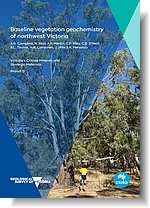
VCMSM Report 12 - Baseline vegetation geochemistry of northwest Victoria.
 |
| |||||||||||||||||||||||||||||
Product description:Executive Summary:As part of the Victorian Critical Minerals Roadmap, new river red gum (Eucalyptus camaldulensis) geochemistry data were collected in northwest Victoria as part of a greater initial reconnaissance baseline geochemistry study. Leaf (160) and bark samples (2) were collected from 160 Eucalyptus camaldulensis trees in early 2026 across an area of 57,000 km2. This included Eucalyptus camaldulensis trees located near demonstrated mineral sand occurrences, which are known to include critical minerals with the following elements: titanium (Ti), zirconium (Zr) and rare earth elements + yttrium (REE). Samples were predominantly collected along river corridors and from the southern Wimmera region, where this species is primarily distributed. Leaf and bark samples were analysed for 66 different elements by microwave-assisted aqua regia digestion. The biogeochemistry of Eucalyptus camaldulensis trees varied across the study area. Concentrations of most nutrients essential for plant function (including calcium, potassium, magnesium and phosphorous) were generally highest in samples from the southwest part of the study area. This is likely indicative of greater tree health in this region, which experiences greater rainfall, lower temperatures and less saline groundwater than the eastern and northern parts of the study area. Dust particles partially influenced the biogeochemistry results from multiple leaf samples, based on measured concentrations of iron (Fe), aluminium (Al), thorium (Th) and zirconium - elements which are common components of windblown dust and/or rarely taken up by plants. These elements were normalised and combined into an index (FATZ) to provide indication of the amount of dust present on each sample. Samples most influenced by dust were from trees situated adjacent to unsealed roads, dry lake beds and the Murray River. The concentration of several other metals, including titanium, hafnium (Hf) and chromium (Cr) displayed a linear relationship with the FATZ index, suggesting these metals were predominantly derived from dust. No clear relationship between high FATZ index values and proximity to mineral sand occurrences was observed. The highest concentrations of rare earth elements were measured in samples from the southwest part of the study area. The elevated concentrations are likely derived from shallow sources (e.g. 0 – 10 m) in the soil/transition zone and showed a tenuous spatial association with mineral sand occurrences. The highest concentrations of FATZ-normalised titanium and zirconium concentrations were also measured in samples near mineral sand occurrences in this region, suggesting that small amounts of these elements may be taken up by Eucalyptus camaldulensis tree roots. Upper quintile concentrations of manganese (Mn), lead (Pb), tin (Sn) and gold (Au) were measured in samples above basement rocks of the Cambrian Mount Stavely Volcanic Complex, which is largely concealed by recent sediments of the Murray Basin. These elements, some of which are known to be elevated in the Mount Stavely Volcanic Complex, are likely taken up by Eucalyptus camaldulensis roots from soil and groundwater. In the eastern part of the study area, upper quintile concentrations of gold and arsenic were measured in Eucalyptus camaldulensis samples in areas where top percentile gold and arsenic concentrations have been observed in soil and groundwater as part of this greater study. The coincidence of elevated gold and arsenic in soil, groundwater and vegetation and the presence of gold mineralisation nearby suggests that this anomalism warrants further investigation. The vegetation geochemical baseline data presented in this report provide a snapshot of river red gum (Eucalyptus camaldulensis) geochemistry in early 2026 in northwest Victoria. It is supplemented by reports on geochemistry in soil (Martin et al., 2026) and groundwater (Campbell et al., 2026) and will be followed by samples and analyses of lake sediments to be presented in a future report. The geochemical baseline data can be used as a basis for future monitoring and evaluation. Bibliographic Reference: Campbell, A.G., Reid, N., Martin, A.P., Riley, C.P., O'Neill, C.D., Thorne, R.L., Lampinen, H.M., Hille, J. & Fenselau, K., 2026. Baseline vegetation geochemistry of northwest Victoria. Victoria's Critical Minerals and Strategic Materials Report 12. Geological Survey of Victoria, Department of Energy, Environment and Climate Action, Melbourne, 64 pp. Download: The downloadable version of this report is supplied as (PDF 68 MB), Attachment A1 (XLSX/ODS 127 KB), Attachment A2 (PDF 1.6 MB) & Attachment A3 (PDF 1.6 MB). Related products:
| ||||||||||||||||||||||||||||||